Solutions

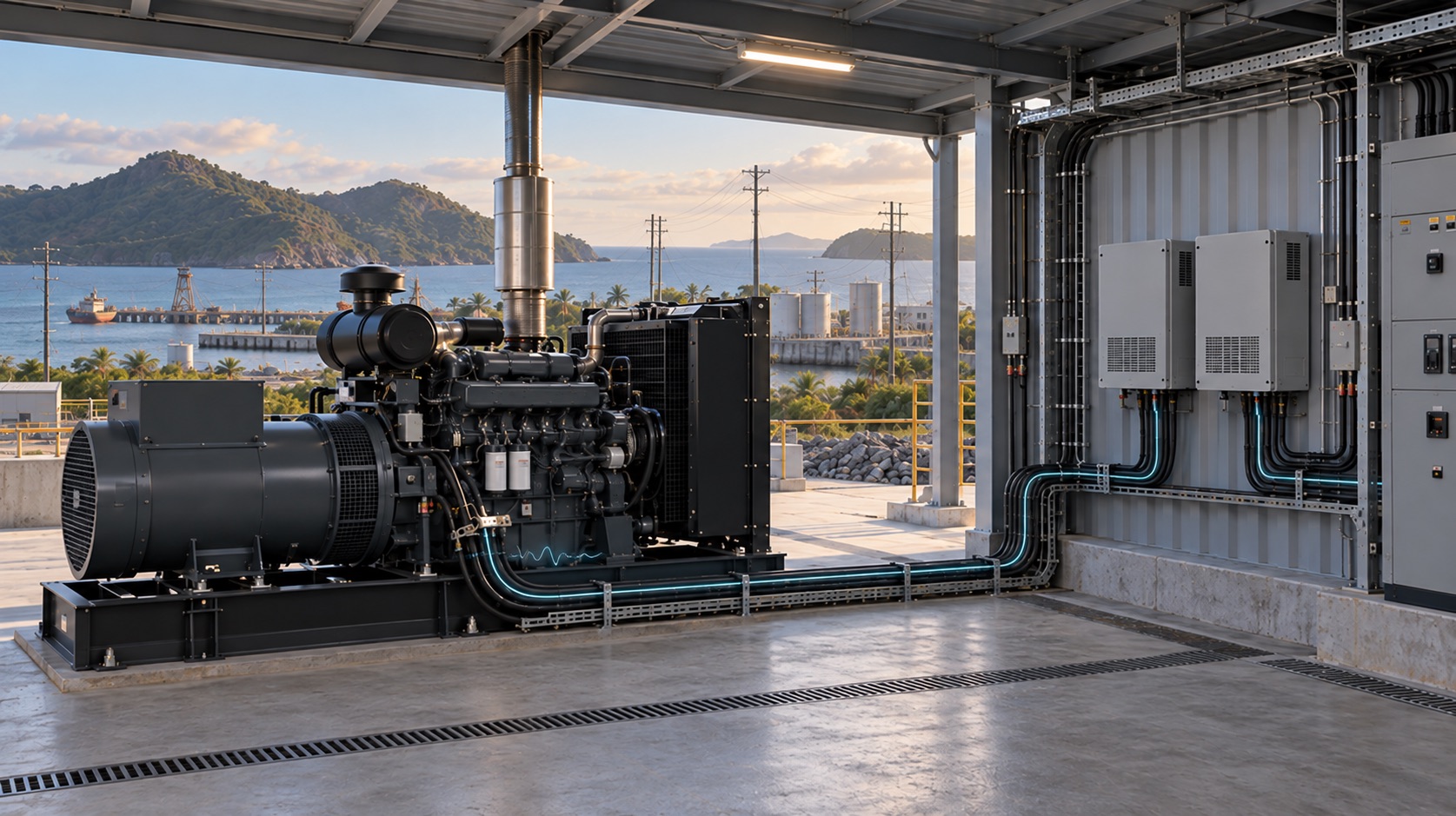
In remote mining areas, industrial parks in Africa, and off-grid islands in Southeast Asia, weak grids or frequent power outages are a daily reality. To maintain production, businesses heavily rely on Diesel Generator Sets (Gensets). However, ensuring these generators run efficiently and stably remains a significant technical challenge.
1. The Basics: What is Reactive Power Compensation and Why is it Essential?
In AC power systems, loads such as motors, transformers, and air conditioners require not only Active Power (to perform actual work) but also Reactive Power to establish magnetic fields.
The Role of Compensation Equipment (SVG)
A Reactive Power Compensation device (like an SVG) acts as an "energy reservoir." It provides the magnetic field energy required by the loads locally, instead of drawing it all the way from the remote grid or the generator.
Why is it Necessary?
● Release Generator Capacity: By reducing reactive current in the lines, the generator can carry more "active" load, preventing the "large engine, small load" inefficiency.
● Reduce Fuel Costs: It minimizes current losses in the cables, directly lowering fuel consumption per kilowatt-hour.
● Stabilize Terminal Voltage: Prevents voltage drops caused by insufficient reactive power, protecting expensive industrial equipment from damage.
● Improve Power Factor: Meets electrical standards and avoids efficiency drops or penalties caused by a low power factor.
2. Working Principle of SVG Reactive Power Compensation Module
In simple terms, the SVG operates like a "Variable Amplitude and Phase Voltage Source." Its internal logic follows a three-step process:
● Signal Detection & Analysis:
The SVG module uses external Current Transformers (CTs) to monitor load current waveforms in real-time. Utilizing algorithms based on Instantaneous Reactive Power Theory, it calculates the exact amount of reactive power deficit and harmonic components in the grid.
● Inverter Output:
The internal controller employs Pulse Width Modulation (PWM) technology to trigger the IGBTs (Insulated Gate Bipolar Transistors) at high frequencies. This converts the DC-side voltage into an AC voltage with the same frequency as the grid.
3. Energy Exchange (The Core Logic):
● Compensating Inductive Loads: When the SVG’s output voltage is higher than the grid voltage, the SVG injects capacitive reactive current into the grid.
● Compensating Capacitive Loads: When the SVG’s output voltage is lower than the grid voltage, the SVG absorbs inductive reactive current.
● Precision Balancing: By adjusting the phase and amplitude of the output voltage, the SVG achieves stepless linear regulation across the entire range from inductive to capacitive power.
4. SVG vs. Traditional Compensation Methods (TSC/TSF)
|
Feature |
Traditional Capacitor Bank (TSC) |
SVG Compensation Module |
|
Response Speed |
20ms to several seconds |
< 5ms (Real-time response) |
|
Regulation Type |
Stepped (Discrete) |
Stepless (Linear) |
|
Compensation Range |
Capacitive only |
Full-range (Inductive to Capacitive) |
|
Harmonic Impact |
Risk of resonance |
Resonance-free; filters harmonics |
|
Size & Lifespan |
Bulky; capacitors degrade fast |
Modular design; long service life |
5, Why Traditional Compensation Fails in Off-grid Environments
Diesel generators are extremely sensitive to load fluctuations. Traditional Capacitor Banks (SVC) often perform poorly when paired with a generator:
● Over-compensation Risk: Capacitors switch in fixed steps. During light loads, they can easily over-compensate, causing the generator voltage to rise and trigger a protective shutdown.
● Slow Response: Generator loads change rapidly, and the multi-second response time of traditional capacitors simply cannot keep up.
● Harmonic Risks: Capacitors can resonate with the system, shortening the lifespan of generator windings.
6, Wall-mounted SVG: The "Stabilizer" for Backup Power Systems
SVG (Static Var Generator) utilizes power electronics (IGBTs) for real-time regulation. In extreme environments like Africa or remote islands, it offers unparalleled advantages:
1) Millisecond Response to Eliminate Voltage Fluctuations
With a response time of less than 5ms, the SVG can instantly provide precise compensation when heavy equipment starts, ensuring the generator doesn't trip and production remains continuous.
2) Bi-directional Continuous Regulation
SVGs provide seamless, stepless adjustment from inductive to capacitive power. It prevents "over-compensation" entirely, solving the issue of generator damage caused by abnormal voltage swings.
3) Compact Wall-mounted Design for Harsh Conditions
● Space-saving: The wall-mounted form factor is ideal for cramped containerized engine rooms or small electrical cabins.
● Easy Maintenance: The modular "plug-and-play" design is crucial for remote areas, significantly reducing maintenance difficulty.
● Built for Extremes: Optimized cooling designs for high-temperature and high-humidity environments ensure long-term stability on tropical islands.
Technical Solution: SVG Reactive Power Compensation for 800kW Off-grid Diesel Generator
We have designed a high-reliability modular compensation system for an 800kW off-grid diesel generator set (700kW load). This solution aims to increase the Power Factor (PF) from 0.75 to 0.98, thereby releasing the generator's rated capacity, reducing winding heat, and enhancing the grid's ability to support large equipment startups in an off-grid environment.
Technical Specifications & Implementation Case Table
|
Category |
Technical Parameters / Implementation Details |
Remarks & Notes |
|
1. Base Conditions |
400kW/800kVA Diesel Gen (Off-grid) |
350kW Load, Initial PF=0.75 |
|
2. Target Goal |
Target Power Factor: 0.98 (Set point 0.95-0.97) |
Reserved margin to prevent off-grid over-compensation |
|
3. Capacity Calculation |
275kvar (Actual Config: 300kvar) |
Precision calculation based on difference |
|
4. Equipment Config |
2 units of 150kvar Wall-mount/Rack Modules |
N+1 redundancy; single module failure won't stop the system |
|
5. Core Power Device |
600V / 200A Industrial Grade IGBT |
Three-level topology to reduce harmonic loss |
|
6. Response Speed |
Full Response Time < 10ms |
Meets the demand for instantaneous load fluctuations |
|
7. Control Algorithm |
Instantaneous Reactive Power Theory (coordinate) |
Ensures balance even under asymmetrical loads |
|
8. Off-grid Strategy |
Soft-start Control + LVRT Capabilities |
Avoids impact on the excitation system during SVG grid-in |
|
9. Sensing & Comm |
CT Sampling at Generator Main + Modbus TCP/RTU |
Real-time monitoring of load rate and temperature rise |
|
10. Cooling & Protection |
Forced Air Cooling / IP20 (In-cabinet) |
Enhanced dust-proof design for engine room environments |
Expected Performance Comparison
|
Performance Metric |
Before Compensation (PF 0.75) |
After Compensation (PF 0.98) |
Optimization Result |
|
Apparent Power (kVA) |
466 kVA |
357 kVA |
Reduced by 110 kVA |
|
Generator Load Rate |
93.3% (High Load Risk) |
71.4% (Safe Zone) |
Released 23.4% Capacity Reserve |
|
Line/Winding Loss |
High (Heat due to high current) |
Reduced by approx. 35% |
Extends engine life, reduces maintenance costs |
|
Voltage Stability |
Significant drop during heavy startup |
Dynamic support, more stable voltage |
Improves reliability of terminal equipment |
Conclusion
For regions relying on diesel generators and microgrids, a Wall-mounted SVG is more than just a compensation device—it is a "lifesaver" for the entire power system. By optimizing the power factor and purifying power quality, it ensures perfect compatibility between generators and complex loads.




Please leave us your messages and feedback, our sales engineers are always right beside you.

